How to manage allergens, options and extras with a QR menu
A QR menu isn't just for displaying a digital menu. Well designed, it can also help a restaurant, bar or hotel better manage allergens, options, extras and order customisations. If this information is poorly managed, the risk is twofold: a poor customer experience and operational errors. A QR menu can reduce these problems by making choices clearer right from the order.
Allergens: information that must be visible
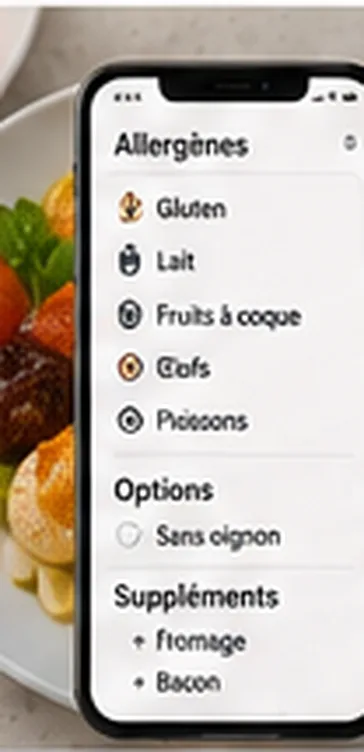
The customer must be able to easily identify products that could be a problem. A QR menu can help clearly display allergens for every product:
A QR menu doesn't replace serious organisation in the kitchen: information must be accurate, up to date and validated. See also our article on prices, allergens and terms on a digital menu.
Options and extras: simplifying customer choice
Options let the customer customise their order without writing a free-text note. These choices can be shown at the right moment, directly on the product card:
Structured options reduce the risk of error compared to an ambiguous free-text note ("not too done", "as usual"). The team then receives an order that's easier to read and prepare. Well-presented extras are also a lever to increase average basket size.
How to organise a QR menu with options
- 1
Create clear categories
Avoid overly long menus: starters, mains, drinks, desserts, cocktails, tapas, set menus...
- 2
Add allergens to every product
The information must be visible, but not overwhelming.
- 3
Use mandatory options when needed
For example, how a burger is cooked or the choice of a side.
- 4
Use optional add-ons for extras
For example, extra cheese, sauce or toppings.
- 5
Limit the number of options
Too many options can slow the customer down and complicate the kitchen.
- 6
Test the menu with the team
Before launching, check that received orders are clear and workable.
QR2App: manage ordering without unnecessary complexity
QR2App lets venues offer QR code ordering without a mandatory POS or an imposed printer. For options, extras and allergens, the benefit is structuring the customer journey and sending clearer orders to the team, via an interface with notifications. To go further, also see our guide to digitising your restaurant menu and our comparison of a simple QR menu vs ordering with payment.
Common mistakes to avoid:
- not displaying allergens
- leaving only a free-text field
- offering too many options
- forgetting the price of extras
- not updating the menu
- not testing the kitchen-side output
FAQ
Can a QR menu display allergens?
Yes, a QR menu can show allergens on every product, provided the information is correctly entered.
Can paid extras be offered?
Yes, extras can be built into the ordering flow along with their price.
Are free-text notes useful?
Yes, but they should not replace structured options for frequent requests.
Why structure options?
It reduces errors, clarifies orders and improves the customer experience.
Does QR2App work without a POS?
Yes, QR2App can work without a mandatory POS.