How to increase table turnover without rushing your customers
Table turnover — the number of times a table is reoccupied during a service — is one of the most powerful revenue levers in a restaurant, and yet one of the most neglected. During a time-limited lunch service or a dinner in a tourist area, each additional table turnover represents a full additional meal sold, without enlarging the dining room or increasing the rent. The challenge above all is not to rush the customer: it is to eliminate the dead time that unnecessarily delays the release of the table. Here is how.
Understanding turnover rate and why it matters
Turnover rate is calculated simply: number of covers served divided by number of seats, over a given period. A 40-seat restaurant that serves 80 covers at lunch has a turnover rate of 2.
Where time is lost: the dead time that kills turnover
The meal itself is not the problem: a customer has every right to take their time at the table. What kills turnover is unwanted waiting — the kind the customer didn't choose and which adds nothing to their experience:
Waiting before being able to order
The customer is ready, but no waiter is available. Several minutes lost, right at the start.
Waiting to ask for, receive and pay the bill
At the end of the meal, the customer wants to leave but has to call a waiter, wait for the bill, wait for payment to be processed, wait for change. This is the most frustrating and most costly downtime for turnover.
Back-and-forth that delays table reset
And therefore the taking of subsequent orders — a bottleneck that ripples through the entire dining room.
Added together, these dead times easily add 10 to 15 minutes to a table's occupation — without any value for the customer. Over a service, this can represent an entire lost turnover.
The levers that genuinely increase turnover
Enable immediate ordering
If the customer can order as soon as they are ready, without waiting for a waiter, you recover the minutes lost at the start of the meal. QR code ordering does exactly that: the customer scans, views the menu and orders at their own pace. The order goes immediately to the kitchen.
Make payment autonomous
This is the most impactful lever for the end of the meal. With table payment, the customer pays when they choose, from their smartphone, without asking for the bill or waiting for processing. As soon as they have paid, they leave, the table is freed, and it is reset for the next customers.
Offer a clear, readable menu
A well-structured digital menu, with photos and descriptions, accelerates the decision. The less the customer hesitates, the faster they order. Decision time also forms part of turnover.
Manage peaks with adapted scheduling
At peak times, the slightest bottleneck (ordering, payment, clearing) ripples through the whole dining room. Staff aligned to peaks and a fluid organisation prevent turnover from being constrained.
Streamline clearing and resetting
A table that has been vacated but not reset is not an available table. Organise clearing so the table is ready as quickly as possible after the customer leaves.
The quantified example of Bec Montmartre

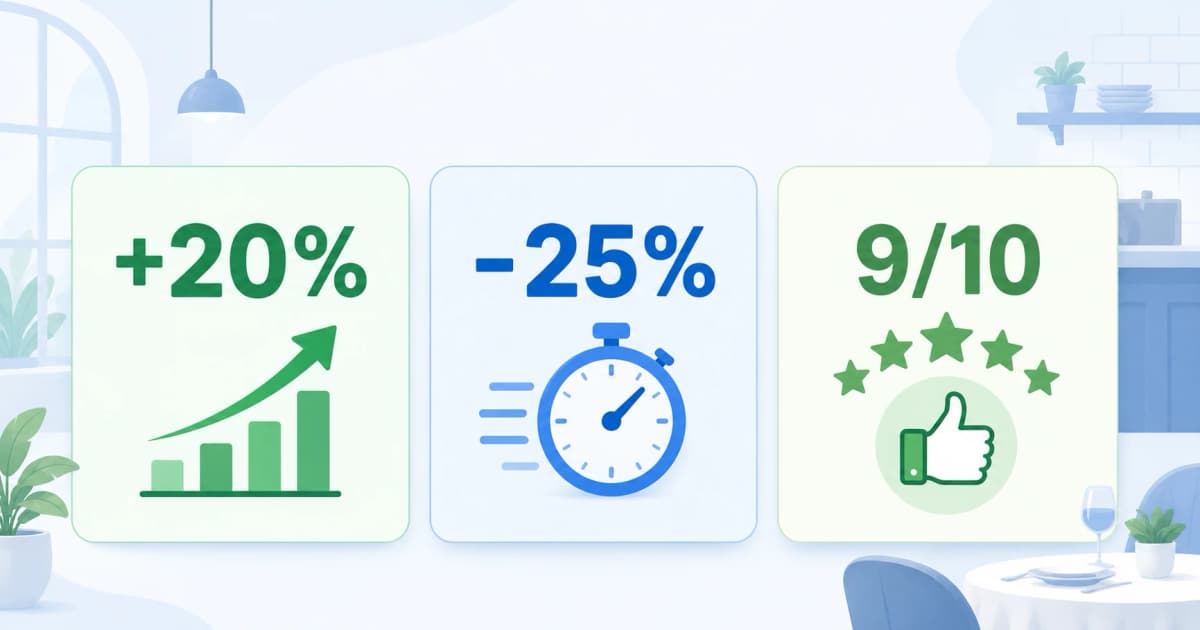
Bec Montmartre restaurant, located in a high-footfall Parisian tourist neighbourhood, deployed QR code ordering and payment with QR2App.
- +20 %table turnover rate
- 9/10customers appreciate ordering autonomy
By eliminating the two main dead times — waiting to order and waiting to pay — the establishment managed to serve more covers per service, without enlarging the dining room or degrading the experience.
Increasing turnover without degrading customer experience
The crucial point: increasing turnover must never be done at the expense of the customer. Rushing people, clearing too quickly or making them feel they should leave damages your reputation. The right approach is to eliminate unwanted friction, not to shorten the pleasure of the meal.
A customer who orders when they want and pays when they want has the feeling of a smoother service that is more respectful of their time. Turnover increases because the experience improves, not the other way around. See also our articles on reducing staff costs and the guide to the QR code menu.
Setting up QR code ordering and payment
With QR2App, activation is simple: digitise your menu, generate and place QR codes on tables, activate secure payment (Stripe, Apple Pay, Google Pay) and receive orders by notification. No mandatory cash register system, no commission and no commitment. You can test on a few tables before rolling out.
FAQ
Does increasing turnover mean rushing customers?
No. It means eliminating unnecessary waiting (ordering, paying), not shortening the meal. The customer stays in control of their time.
What turnover gain can you expect?
It depends on the establishment, but eliminating the two main dead times delivered +20% at Bec Montmartre. The effect is especially noticeable at peak hours.
Do you need a POS system for table payment?
No. QR2App handles ordering and payment without a mandatory POS.
Read also
Serve more covers, without enlarging your dining room.
No commitment, no commission.
Request a free demo